Milligrams to Micrograms to Syringe Units: A Peptide Unit Conversion Guide
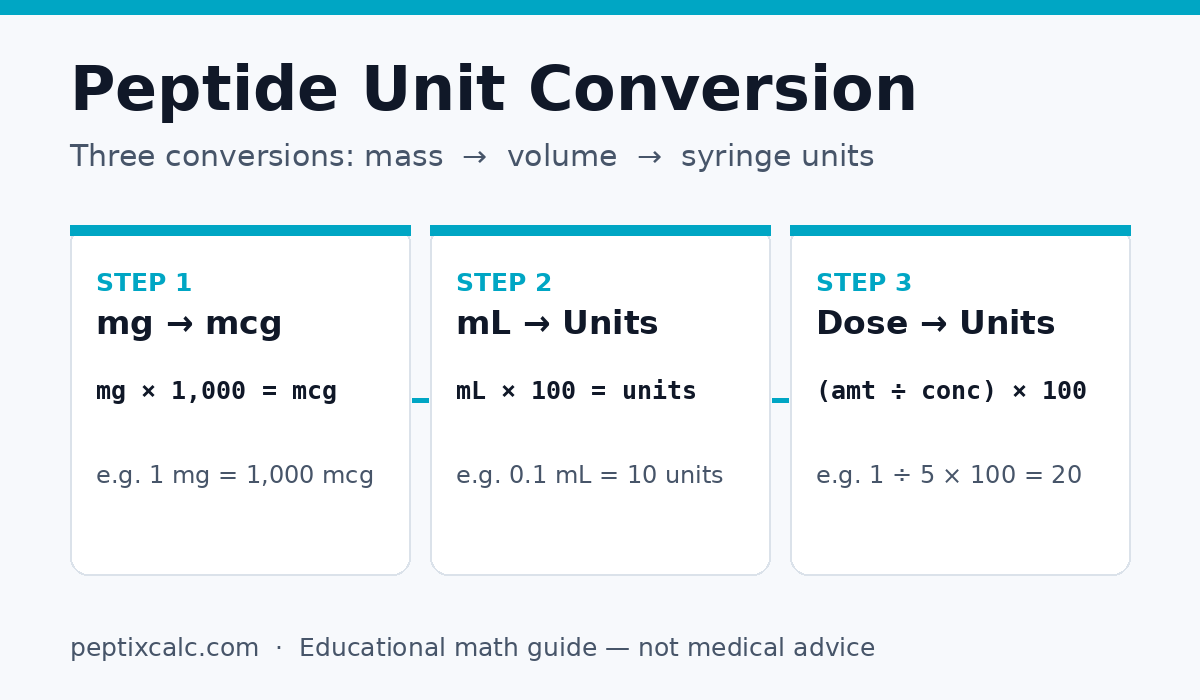
Quick answer: 1 mg = 1,000 mcg (multiply mg by 1,000; divide mcg by 1,000). On a U-100 syringe, 1 mL = 100 units (multiply mL by 100; divide units by 100). There is no fixed mg-to-units conversion — syringe units measure liquid volume, so converting an amount (mg/mcg) to units requires knowing the solution’s concentration (mg/mL or mcg/mL).
Peptide labels, calculators, and syringe barrels use three different unit families: milligrams and micrograms (mass), millilitres (volume), and syringe units (barrel markings). Confusing one family for another is the source of most tenfold arithmetic errors. This guide explains how to convert within and between these families — the mathematics only. It does not recommend any dose, preparation method, or product. Product labeling and a qualified healthcare professional take precedence over any calculation shown here.
What Each Unit Measures
Before converting, it helps to sort the units by what they describe:
- Milligrams (mg) and micrograms (mcg): units of mass — how much peptide there is. Labels state vial contents and amounts in these units.
- Millilitres (mL): a unit of volume — how much liquid there is.
- Syringe units: markings on the syringe barrel describing volume, not mass. On a standard U-100 insulin syringe, the 1 mL barrel is divided into 100 units, so 1 unit = 0.01 mL [1][2].
The critical point: a syringe’s unit markings tell you how far up the barrel the liquid reaches. They say nothing about how much peptide is dissolved in that liquid. That is why “how many units is 1 mg?” has no single answer — it depends on the concentration of the specific solution.
Conversion 1: Milligrams ↔ Micrograms
This is a fixed metric conversion, independent of any solution:
mcg = mg × 1,000
mg = mcg ÷ 1,000
| mg | mcg |
|---|---|
| 0.1 mg | 100 mcg |
| 0.25 mg | 250 mcg |
| 0.5 mg | 500 mcg |
| 1 mg | 1,000 mcg |
| 2 mg | 2,000 mcg |
| 5 mg | 5,000 mcg |
| 10 mg | 10,000 mcg |
Always express both values in the same unit before doing any further arithmetic. Mixing mg and mcg in one calculation is the most common source of 1,000-fold errors.
Conversion 2: Millilitres ↔ Syringe Units (U-100)
On a U-100 syringe — the standard for this kind of measurement — the barrel holds 1 mL divided into 100 units [1]:
units = mL × 100
mL = units ÷ 100
| mL | U-100 units |
|---|---|
| 0.01 mL | 1 unit |
| 0.05 mL | 5 units |
| 0.10 mL | 10 units |
| 0.20 mL | 20 units |
| 0.25 mL | 25 units |
| 0.50 mL | 50 units |
| 1.00 mL | 100 units |
U-40 syringes are graduated differently: 1 mL = 40 units [1]. On a U-40 barrel, multiply mL by 40 (not 100). Always confirm which syringe is in hand before converting — the formulas in this guide assume U-100 unless stated otherwise.
The Missing Link: Concentration
Conversions 1 and 2 are fixed. But converting an amount (mg or mcg) directly to syringe units is not fixed — it requires the solution’s concentration, i.e. how much peptide is dissolved per millilitre:
Concentration (mg/mL) = peptide in solution (mg) ÷ liquid volume (mL)
Once concentration is known, the chain is:
units = (amount ÷ concentration) × 100 (U-100)
Every entry must use consistent units: if the amount is in mcg, the concentration must be in mcg/mL (multiply a mg/mL concentration by 1,000 first).
Hypothetical Worked Example
Suppose — hypothetically — a solution contains 10 mg of peptide in 2 mL of liquid, and the amount of interest is 1 mg. The arithmetic would be:
Step 1 — Concentration:
10 ÷ 2 = 5 mg/mL
Step 2 — Volume for the amount:
1 ÷ 5 = 0.2 mL
Step 3 — Syringe units (U-100):
0.2 × 100 = 20 units
The same chain in micrograms: 1 mg = 1,000 mcg; concentration = 5,000 mcg/mL; 1,000 ÷ 5,000 = 0.2 mL; 0.2 × 100 = 20 units. Same result — a useful cross-check.
A second hypothetical: an amount of 500 mcg from the same 5 mg/mL solution. 500 mcg = 0.5 mg; 0.5 ÷ 5 = 0.1 mL; 0.1 × 100 = 10 units.
These are mathematical demonstrations only — not instructions to prepare, measure, or administer anything.
Where the Arithmetic Goes Wrong
Five common errors, and how to avoid each:
- Assuming a fixed mg-to-units conversion. “1 mg = X units” is meaningless without a concentration. The same 1 mg is 20 units at 5 mg/mL and 40 units at 2.5 mg/mL.
- Mixing mg and mcg. Dividing a mcg amount by a mg/mL concentration (or vice versa) without converting first produces a 1,000-fold error.
- Reading units as mass. Syringe units measure volume. Ten units drawn from one solution and ten units from another can contain completely different amounts of peptide.
- Wrong syringe scale. Using the ×100 factor on a U-40 syringe (or ×40 on a U-100) [1]. Check the barrel before converting.
- Confusing math with suitability. A correct conversion does not establish an appropriate amount, a compatible diluent, a safe preparation method, sterility, stability, or a suitable administration route. Those require the product’s labeling and a qualified professional.
Frequently Asked Questions
How many micrograms are in 1 milligram?
Exactly 1,000 mcg. Multiply mg by 1,000 to get mcg; divide mcg by 1,000 to get mg.
How many units are in 1 mL on a U-100 syringe?
Exactly 100 units. The U-100 designation means the barrel is calibrated for 100 units per millilitre, so 1 unit = 0.01 mL [1][2].
Can I convert mg directly to syringe units?
Not without the concentration. First convert the amount to a volume using concentration (amount ÷ concentration), then convert volume to units (×100 for U-100). Any chart showing “X mg = Y units” is implicitly assuming a specific concentration — check what it assumed.
What’s the difference between U-100 and U-40 syringes?
A U-100 syringe reads 100 units per mL; a U-40 reads 40 units per mL [1]. The same 0.5 mL of liquid shows as 50 units on a U-100 and 20 units on a U-40. Always read the syringe in hand.
Are syringe units the same as IU?
No. Syringe “units” are volume markings on the barrel. “IU” (international units) measure biological activity and are product-specific — the two are not interchangeable.
Putting It Together
Unit conversion is the vocabulary; the full calculation is the sentence. Once these conversions are comfortable, the complete workflow — from vial size and diluent volume to the syringe marking — is explained step by step in our peptide reconstitution calculation guide. To run the numbers directly, try the peptide reconstitution calculator or work backwards from a syringe reading with the reverse peptide calculator. For conversions involving molecular weight, see the molecular weight calculator.
All examples are hypothetical mathematical illustrations. They do not establish an appropriate dose, a compatible diluent, a safe preparation method, sterility, stability, or a suitable administration route.
Sources
[1] ADW Diabetes, “Insulin Syringes 101” — https://www.adwdiabetes.com/articles/insulin-syringes-101 (U-100 = 100 units/mL; U-40 = 40 units/mL; verified 2026-10-19)
[2] DailyMed (U.S. National Library of Medicine), Lantus (insulin glargine) FDA label — “Injection: 100 units/mL (U-100)” — https://dailymed.nlm.nih.gov/dailymed/drugInfo.cfm?setid=d5e07a0c-7e14-4756-9152-9fea485d654a (verified 2026-10-24; page text confirms the claim)
