Peptide Calculator
Real-Time & Accurate Dosage Tool
You can easily calculate accurate peptide doses with our peptide calculator tool. Our smart tool helps you find the right dosage in mg, mcg, IU, or mL without doing complex manual calculations. You get instant results based on your peptide amount, water volume, and desired dose. With features like real-time calculations, dosage charts, and unit conversions, you can manage your peptide dosing safely and with confidence.

Peptide Dosage Calculator
Enter your details to calculate the exact syringe dose for you.
Multi Peptide Blend Calculator
Enter your details to calculate the right dosage for a mix of multiple peptides in one vial.
Peptide Dosage Schedule Planner
Feel free to plan your weekly peptide schedule and easily track your doses.
Your Previous Calculations
Check your previous calculations here, and you can also export them if you want.
Peptide Library
Here you can check out common research peptides and their profiles.
A peptide calculator converts your vial size, the bacteriostatic water you add, and your desired dose into the exact number of syringe units to draw. PeptixCalc does this instantly: enter your vial's peptide amount in mg, your BAC water in mL, and your target dose in mcg, and it returns your concentration, mcg per unit, and the precise units to draw on a U-100, U-50, or U-30 syringe.
There's no manual mg-to-mcg conversion and no guesswork. Results update in real time as you adjust any value, so you can compare dilutions before you draw. Researchers, students, and lab professionals use it to plan and double-check reconstitution ratios.
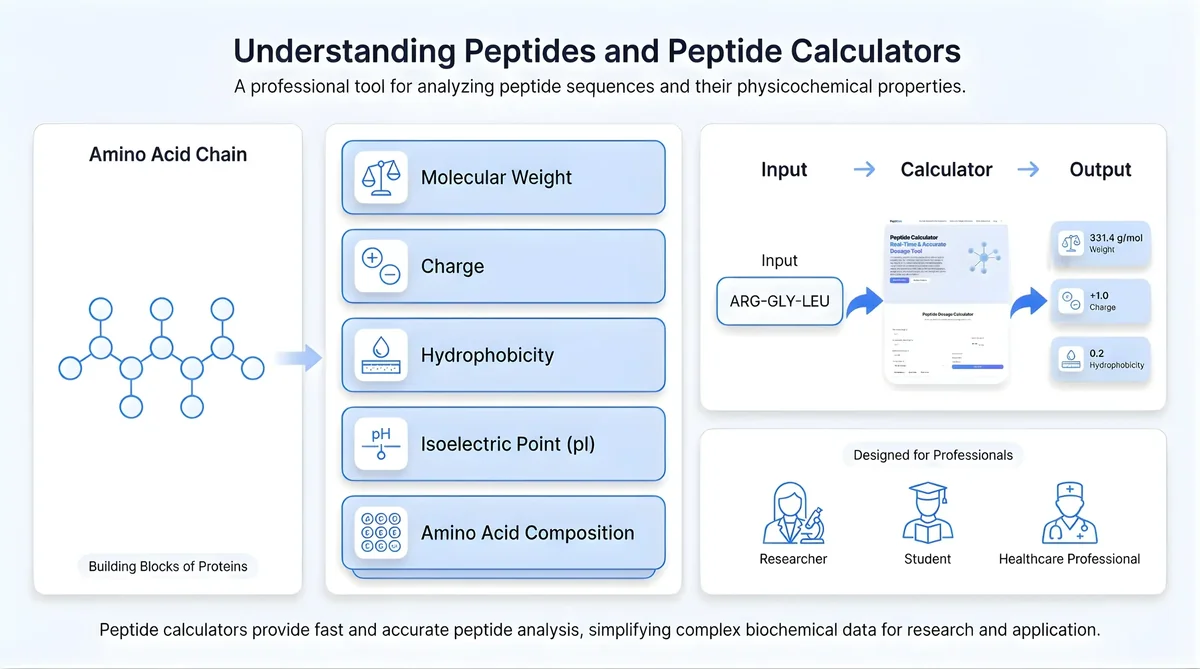
How to Use the Peptide Calculator?
We have designed our peptide reconstitution calculator to be easy to use, so that everyone can use this calculator to analyze their peptides. Below is a detailed guide:
Step No 1: Set Your Desired Dose
The first step is the selection of the desired peptide intake. This is expressed as micrograms, mcg. You should insert your figure here. If your planned dose per injection is 250 mcg, insert “250 mcg.”
Step No 2: Enter the Total Peptide Amount
The second step involves entering the amount of the peptide that you have in your vial. Typically, you might have 1 mg, 5 mg, 10 mg, or 15 mg in your vial, but you can enter any amount you want depend on the amount you have. This step is crucial in helping you get the concentration of your solution.
Step No 3: Add the Water Volume
Now, you can enter the volume of bacteriostatic water (in mL) used to dissolve the peptide. This will also determine the volume of liquid that you need to withdraw for each injection. For instance, if you add 1 mL of water to a 5 mg vial, it will be a different concentration than if you add 2 mL of water.
Step No 4: Check the Visual Dosage Meter
Once all values are entered, the calculator will display a visual dosage meter. This meter will show exactly how much solution to draw into your syringe to get the exact dose required. For example, if your required dose is 250 mcg, the meter will show exactly what volume in milliliters (or units if using insulin syringe) is required.
What is a Peptide Calculator?
The online peptide calculator is a tool used for the analysis of peptide sequences. It is also used to calculate the important properties of a peptide. It works on the principle of using the chemical data of the given peptide.
This tool is used in biochemistry, molecular biology, and pharmaceutical research. It helps to save time and avoid calculation mistakes. Instead of performing complex and time-consuming calculations, you can obtain quick and accurate results by simply entering a few values.
How Peptide Dosage Is Calculated?
You can calculate peptide dosage using a simple formula:
This formula considers the quantity of peptide within your vial, the quantity of solution you’re utilizing, and the dose you are planning to administer. By entering this data into our easy peptide calculator, you can accurately calculate exactly how much solution to draw up within your syringe.
Desired Dose
Amount you want per injection
Total Volume
Liquid added to dissolve peptide
Peptide Amount
Total mg in vial
Worked Example
Say you have a 5 mg vial of peptide and add 2 mL of bacteriostatic water. That gives a concentration of 2.50 mg/mL (2,500 mcg/mL). On a U-100 syringe (100 units/mL), that works out to 25.0 mcg per unit. If your target dose is 250 mcg, you would draw 250 ÷ 25 = 10.0 units per injection, and the 5 mg vial gives you 20 doses in total.
Who Should Use This Peptide Calculator?
You can use the peptide calculator dosage if you are working with peptides as part of research, education, or product development activities.
If you are a student, you can use this calculator to make your learning about peptides more interesting. For a researcher, a biotechnologist, or a developer of supplements, this calculator can be a handy tool to assist you in your planning and to ensure correct dosages. In the laboratory itself, you can also use this calculator to help you avoid mistakes or to save more time.
Benefits of Using Our Peptide Tool
The use of a peptide tool can bring many benefits to researchers, students, and professionals. It can assist users in making complex calculations simpler. The major benefits associated with the use of a peptide tool are as follows:
Peptide Dosage for Beginners
If you’re new to peptides, you can start with a safe and low dosage. Most beginner doses range from 100 to 300 mcg per day, depending on the peptide type. Always follow instructions provided with the peptide or by your healthcare professional.
You can set your dose and see exactly how much solution to draw. This helps you to stay consistent and avoid overdosing. Starting low also allows you to monitor effects safely before adjusting the dosage.
Factors That Affect Peptide Dosage
The correct dosage of the peptide may vary from person to person. There are a number of important factors that need to be considered in order to establish the correct dosage for you. You will be able to use the peptide safely.
Body Weight and Size
Your body weight is a factor that affects the peptides in your system. If you are on the heavier side, you may need a little more, and if you are on the lighter side, you may need less. It is helpful to adjust the doses based on your body weight.
Age and Metabolism
Your metabolism will help you understand how fast your body can metabolize the peptides. Some people may be younger or have a fast metabolism compared to others. However, taking the peptide is necessary to ensure its efficiency without abuse.
Peptide Type and Potency
The potency of various peptides varies. Some are very potent, requiring small quantities, while others require larger quantities to produce the desired results. The identification of the peptides helps avoid overdosing and ensures the desired results are obtained.
Purpose of Use
The reason you are using the peptide can greatly affect the dosage. Peptides can be used for research purposes or fitness/therapeutic purposes, which can have different dosing requirements. Using a calculator can help you to set a dose appropriate to your goal or requirement safely.
mg to mcg and mL Conversion Guide
Peptides are measured in milligrams, but the dosage is in micrograms. Remember the following conversion:
- 1 mg = 1000 mcg
- Volume in milliliters (mL) affects concentration: the more water used, the more diluted the solution will be. The less water used, the more concentrated the solution will be.
Our calculator will do the conversion for you. This way, you don't have to think about the mcg or the mL.
Peptide Dosage Chart
Here’s a simple guide to typical peptide dosages that you can use as a starting point.
| Level | Typical Dosage (mcg/day) |
Who It's For |
Notes |
|---|---|---|---|
| Beginner | 100 – 300 mcg | If you are new to peptides |
Start low and monitor your response |
| Intermediate | 300 – 500 mcg | If you have some experienced |
Adjust based on results and tolerance |
| Advanced | 500 – 1000 mcg | If you are experienced |
Use carefully and avoid sudden increases |
You may adjust the dosage according to the type of peptide, response, and objectives. The calculator will assist you in obtaining the precise dosage depending on the size of the vial and the water.
Peptide Dosage Safety Guidelines
To ensure your safety while using these peptides:
- Start with a low dose and see how you react.
- Do not exceed the recommended daily intake.
- Use clean syringes and sterile water to prepare your solution.
- Store peptides properly to maintain potency.
When to Avoid Using Peptides?
If you are not sure, you can always consult a medical professional before using peptides.
- Pregnant or breastfeeding
- Serious medical condition without the doctor approval.
- Under 18 or using peptides for non-research purposes without guidance.
Peptide Storage and Handling
Storage is important for the effective use of peptides. Most peptides should:
- Stored in a cool, dry place or refrigerator
- Avoid direct sunlight and moisture
- Use clean equipment to handle the peptides
Common Peptide Dosage Mistakes to Avoid
Careful administration is key to safety and results. Be mindful of these common errors:
Skipping the Calculator
Estimating dosages visually instead of using exact calculator measurements can lead to severe under or overdosing.
Incorrect Solvent Volume
Failing to account for the exact volume of bacteriostatic water used during reconstitution throws off the entire dosage ratio.
Ignoring Peptide Purity & Type
Not all peptides are dosed identically. Treating high-purity or different strains of peptides equally can cause adverse reactions.
Rapidly Increasing Dosage
Impatience leads to bypassing the crucial adaptation phase. Always increase dosages slowly and systematically based on tolerance.
Improper Storage and Handling
Leaving reconstituted peptides at room temperature or exposing them to violent shaking degrades their molecular structure quickly.
Not Monitoring Effects
Ignoring your body's biofeedback. You must carefully track intended benefits and side effects to dial in your optimal dose.
Pros and Cons of Peptide Calculators
The benefits outweigh the drawbacks if you use the tool responsibly.
✅ Pros
- Provides accurate dosage instantly
- Saves time and reduces errors
- Adjusts for peptide type, vial size, and water volume
⚠️ Cons
- Reliant on correct input values
- Doesn't replace medical advice
- Not all calculators include advanced modifications
Peptide Calculator vs Manual Calculation
You could calculate peptide dosage manually, but it’s time-consuming. Manual calculations require:
- Converting mg to mcg
- Accounting for water volume
- Calculating concentration and dose per injection
Our calculator does all this instantly, reducing errors and saving effort. You’ll get a visual meter or number that tells you exactly how much solution to draw.
Is This Peptide Calculator Accurate?
Yes, our calculator is highly accurate when you enter the correct data. It considers for:
- Peptide amount in the vial
- Solvent volume
- Desired dosage in mcg
Using the calculator eliminates the guesswork involved in manual calculations, ensuring you draw the right amount of solution every time. You can trust it for consistent dosing, whether you’re a beginner or an experienced user. Always double-check your inputs, and combine its use with safe handling and storage practices for the best results.
My Experience Using This Peptide Tool
When I started using the peptide tool, I immediately noticed how much easier it made dosing. Before, I had to manually convert mg to mcg and calculate how much solution to draw, which was time-consuming and prone to errors.
With the calculator, I simply entered the peptide amount, water volume, and desired dose, and it gave me an exact measurement to use. It saved me time, reduced mistakes, and made my peptide preparation much more consistent.
You will also find it helpful if you want to track dosage, avoid mistakes, and plan experiments or personal use with confidence.
Frequently Asked Questions
The peptide calculator units section shows results in different formats like mcg, mg, mL, or syringe units. This helps you understand exactly how much to measure. It makes the dosing process clearer and more practical.
The calculator displays your peptide’s concentration (mg/mL or mcg/mL), the volume to draw, and how many doses are in the vial. This helps you plan injections safely and accurately.
Yes, our peptide tool is mobile-friendly. You just need your peptide details and solvent volume to get instant results on any device.
A peptide calculator mg works by converting the peptide amount from milligrams into micrograms automatically. You just enter the total mg in your vial, and the tool handles the rest. This prevents mistakes when switching between units.
Yes, a peptide tool by weight allows you to calculate dosage based on your body weight. You enter your weight and the recommended dose per kg, and the calculator gives a personalized result. This is commonly used in research settings.
A peptide tool IU can help, but you may need to convert IU to mg first depending on the peptide. Some calculators support IU directly, while others require manual conversion. Always check your peptide label before calculating.
Final Words
A peptide calculator is a powerful tool that helps you work with peptides safely and accurately. It gives you instant insights into dosage, concentration, and peptide properties, so you don’t have to guess or do complex calculations yourself. By using this tool, you can plan your doses, monitor effects, and manage peptides efficiently. It ensures that every injection or experiment is precise, reducing errors and giving you confidence in your results.
With our peptide tool, you make peptide preparation simple, accurate, and stress-free, helping you get the most out of every peptide safely and effectively.
Trusted by Researchers
"The most intuitive peptide calculator I've used. The blend feature is a game changer for complex research protocols."
"Clean, fast, and accurate. The dark mode is perfect for late-night lab sessions. Highly recommended."
"PeptixCalc has streamlined our peptide dosing workflow. The protocol builder keeps our entire team aligned."
"The level of detail and clarity in the calculations is outstanding. It feels like having a second set of expert eyes."
"Our lab relies on PeptixCalc daily. The blend calculator alone has reduced our preparation errors significantly."
"Elegant interface, precise outputs. This is exactly the type of tool I expect in a modern research environment."
"Being able to export history and protocols makes documentation effortless. Our audits are smoother than ever."
"From trainees to senior staff, everyone picked it up in minutes. It removes ambiguity from peptide dosing."