How to Calculate Peptide Reconstitution: Step-by-Step Math Guide
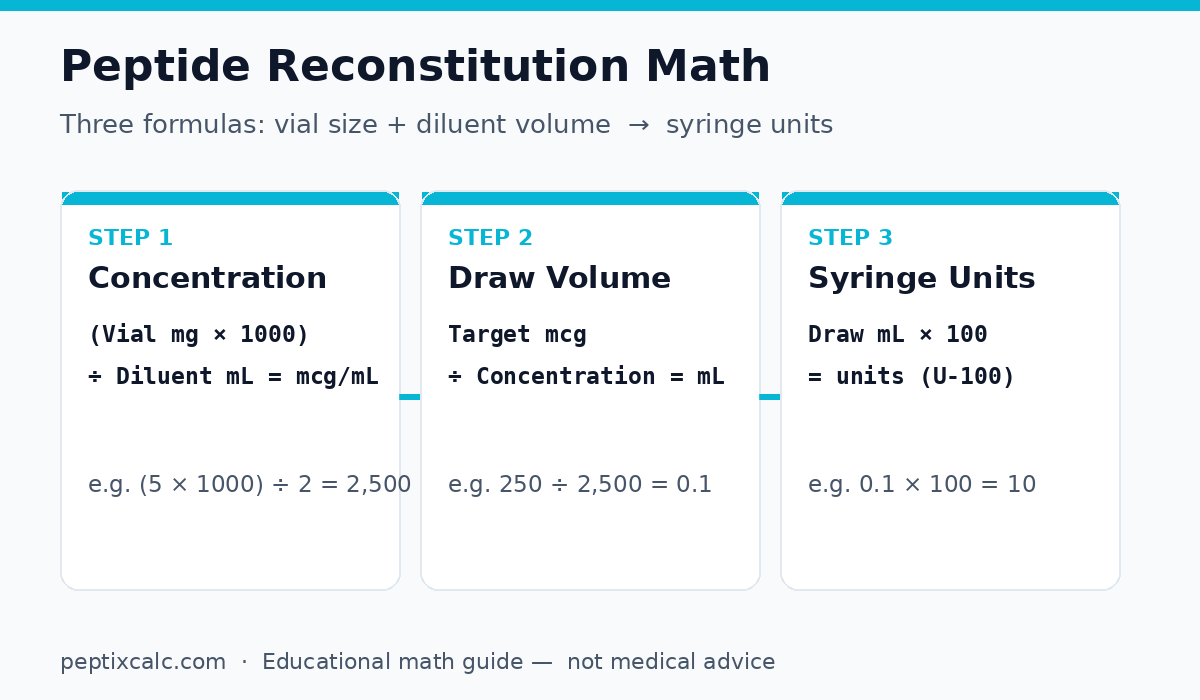
Quick answer: Divide the vial’s peptide (mg × 1000) by the diluent volume (mL) to get concentration in mcg/mL. Divide the target amount (mcg) by that concentration to get the draw volume in mL. Multiply by 100 for U-100 syringe units. Example: (5 × 1000) ÷ 2 = 2,500 mcg/mL; 250 ÷ 2,500 = 0.1 mL; 0.1 × 100 = 10 units.
Peptide reconstitution involves arithmetic that looks intimidating at first, but it reduces to three divisions. This guide explains those calculations: given a vial size, a diluent volume, and a target amount, the formulas below show how to derive the corresponding syringe marking.
This guide covers the mathematics only. It does not recommend any dose, preparation method, or product. Actual product instructions and guidance from a qualified healthcare professional take precedence over any calculation shown here.
The Three Formulas
Step 1: Calculate Concentration
Divide the total peptide in the vial by the volume of diluent added.
Concentration (mcg/mL) = (Vial mg × 1000) ÷ Diluent mL
The × 1000 converts milligrams to micrograms. Many peptide amounts are expressed in micrograms, though units vary by product and its instructions — always follow the specific product labeling for which unit applies.
Step 2: Calculate Draw Volume
Divide the target amount by the concentration.
Draw volume (mL) = Target amount (mcg) ÷ Concentration (mcg/mL)
This gives the liquid volume corresponding to the target amount.
Step 3: Convert to Syringe Units
Multiply the draw volume by 100 (for a standard U-100 insulin syringe, where 100 units = 1 mL).
Syringe units = Draw volume (mL) × 100
On a U-100 syringe, 0.1 mL corresponds to the 10-unit mark, 0.25 mL to 25 units, and so on [1].
Hypothetical Worked Example
Suppose — hypothetically — a vial contains 5 mg of peptide, 2 mL of diluent is added, and the target amount is 250 mcg. The arithmetic would be:
Step 1 — Concentration:
(5 × 1000) ÷ 2 = 5000 ÷ 2 = 2,500 mcg/mL
Step 2 — Draw volume:
250 ÷ 2500 = 0.1 mL
Step 3 — Syringe units:
0.1 × 100 = 10 units
The calculation yields the 10-unit mark on a U-100 scale. This is a mathematical demonstration only — not an instruction to prepare, measure, or administer anything.
The Micrograms-Per-Unit Shortcut
Once you know the concentration, you can also calculate how much peptide each syringe unit represents:
mcg per unit = Concentration (mcg/mL) ÷ 100
For the example above: 2,500 ÷ 100 = 25 mcg per unit. Then 250 mcg ÷ 25 mcg/unit = 10 units — same result, useful as a cross-check.
How to Double-Check the Arithmetic
Multiply the result back through the chain:
10 units = 0.1 mL. At 2,500 mcg/mL, that’s 0.1 × 2500 = 250 mcg. ✓ Matches the target.
If the numbers don’t match, recheck Step 1 — most arithmetic errors come from the mg-to-mcg conversion.
Choosing a Diluent Volume
The diluent and its volume are not a matter of arithmetic convenience. Which diluent is compatible, and how much to use, must follow the specific product’s applicable instructions and compatibility requirements. Arithmetic cannot establish suitability: choosing a volume to obtain round syringe-unit markings does not make that volume appropriate for a given product.
Whatever volume the product instructions specify, the same three-step calculation applies — but if the volume changes, the concentration changes, so the calculation must be redone from Step 1.
Common Combinations (Reference Table)
| Vial | Diluent | Concentration | mcg per unit | For 250 mcg (hypothetical) |
|---|---|---|---|---|
| 5 mg | 1 mL | 5,000 mcg/mL | 50 mcg | 5 units |
| 5 mg | 2 mL | 2,500 mcg/mL | 25 mcg | 10 units |
| 10 mg | 2 mL | 5,000 mcg/mL | 50 mcg | 5 units |
| 10 mg | 3 mL | 3,333 mcg/mL | 33.3 mcg | 7.5 units |
Hypothetical mathematical examples only. These numbers do not establish an appropriate dose, a compatible diluent, a safe preparation method, sterility, stability, or a suitable administration route — those require the product’s labeling and professional guidance.
Where the Arithmetic Goes Wrong
Five common errors, and how to avoid each:
- Milligrams read as micrograms. Skipping the × 1000 creates a 1,000-fold error — the most frequent mistake. Always express both values in the same unit before dividing.
- Volume read as units. Syringe units are hundredths of a millilitre on a U-100 barrel. A result in mL must be multiplied by 100 before reading it off the syringe.
- Wrong syringe scale. U-40 and U-100 syringes are graduated differently [1]. Confirm which barrel is in hand before converting.
- Results between graduations. A result like 7.3 units cannot be measured precisely on most syringes. The calculation above shows the arithmetic result; whether any given draw volume is appropriate depends on the product’s instructions and professional guidance.
- Confusing math with medical suitability. A correct calculation does not establish an appropriate dose, a compatible diluent, a safe preparation method, sterility, stability, or a suitable administration route. Those require the product’s labeling and a qualified professional.
Frequently Asked Questions
What is peptide reconstitution?
Reconstitution is the process of adding a diluent (often bacteriostatic water — a sterile preparation containing 0.9% benzyl alcohol as preservative [2]) to a lyophilized (freeze-dried) peptide vial, turning the powder into a liquid solution that can be measured with a syringe. The appropriate diluent, technique, and storage conditions depend on the specific product and its instructions.
Why do I need to calculate instead of just estimating?
Syringe markings show volume (mL or units), not the amount of peptide (mcg or mg). Without the calculation, the amount of peptide in a given volume is unknown. This guide explains the arithmetic; it does not advise what amount is appropriate — that requires the product’s instructions and professional guidance.
What’s the difference between U-100 and U-40 syringes?
A U-100 syringe is calibrated so that 1 mL equals 100 units; a U-40 syringe is calibrated so that 1 mL equals 40 units [1]. The formulas above assume U-100. For U-40, multiply the draw volume by 40 instead of 100 in Step 3. Always confirm which syringe type matches your product’s instructions.
Can I use this math for any peptide?
The arithmetic — division and multiplication — works the same regardless of compound. However, the math alone does not determine whether a product is suitable for a given purpose, which diluent is compatible, whether sterility is maintained, or what route of administration applies. Those questions depend on the specific product, its labeling, and guidance from a qualified professional. This guide addresses only the calculation.
Try It Yourself
Use our peptide reconstitution calculator to run these calculations instantly. If you know the injection volume but not the corresponding amount, try the reverse peptide calculator.
Sources
[1] ADW Diabetes. “Insulin Syringes 101.” https://www.adwdiabetes.com/articles/insulin-syringes-101 — U-100 (100 units/mL) and U-40 (40 units/mL) syringe calibration.
[2] DailyMed (U.S. National Library of Medicine). “BACTERIOSTATIC WATER for Injection, USP.” https://dailymed.nlm.nih.gov/dailymed/fda/fdaDrugXsl.cfm?setid=69485218-9343-952d-e053-2a91aa0ad4e8 — Official FDA labeling: “sterile, nonpyrogenic preparation of water for injection containing 0.9% (9 mg/mL) of benzyl alcohol added as a bacteriostatic preservative.”
[3] CDC. “Injection Safety: Clinical Safety.” https://www.cdc.gov/injection-safety/hcp/clinical-safety/index.html — Guidance on aseptic technique, single-use vs multi-dose vials, and safe injection practices.
Safety note: This article explains mathematical calculations for educational purposes. It is not medical advice and does not recommend any dose, preparation method, or product. Peptides are for research purposes only. Always follow the actual product instructions, and consult a qualified healthcare professional. Product instructions and professional guidance take precedence over any calculation shown here or produced by any calculator. For safe injection practices including aseptic technique and vial handling, see CDC guidance [3].
